

New Zealand's Business Investor Work Visa (BIV) has been updated effective 6 July 2026, with three practical changes that expand how offshore investors can structure and fund their entry into New Zealand business ownership. If you have been watching this pathway — or advising clients who have — now is a good time to reassess eligibility.
What Is the Business Investor Work Visa?
The BIV is designed for experienced business people who want to invest in and actively operate an established New Zealand business. It is a work visa, not a passive investment vehicle — the expectation is that you will be running the business day to day, and that your capital, expertise, and global connections will contribute to its growth.
The pathway leads to permanent residence. The key numbers:
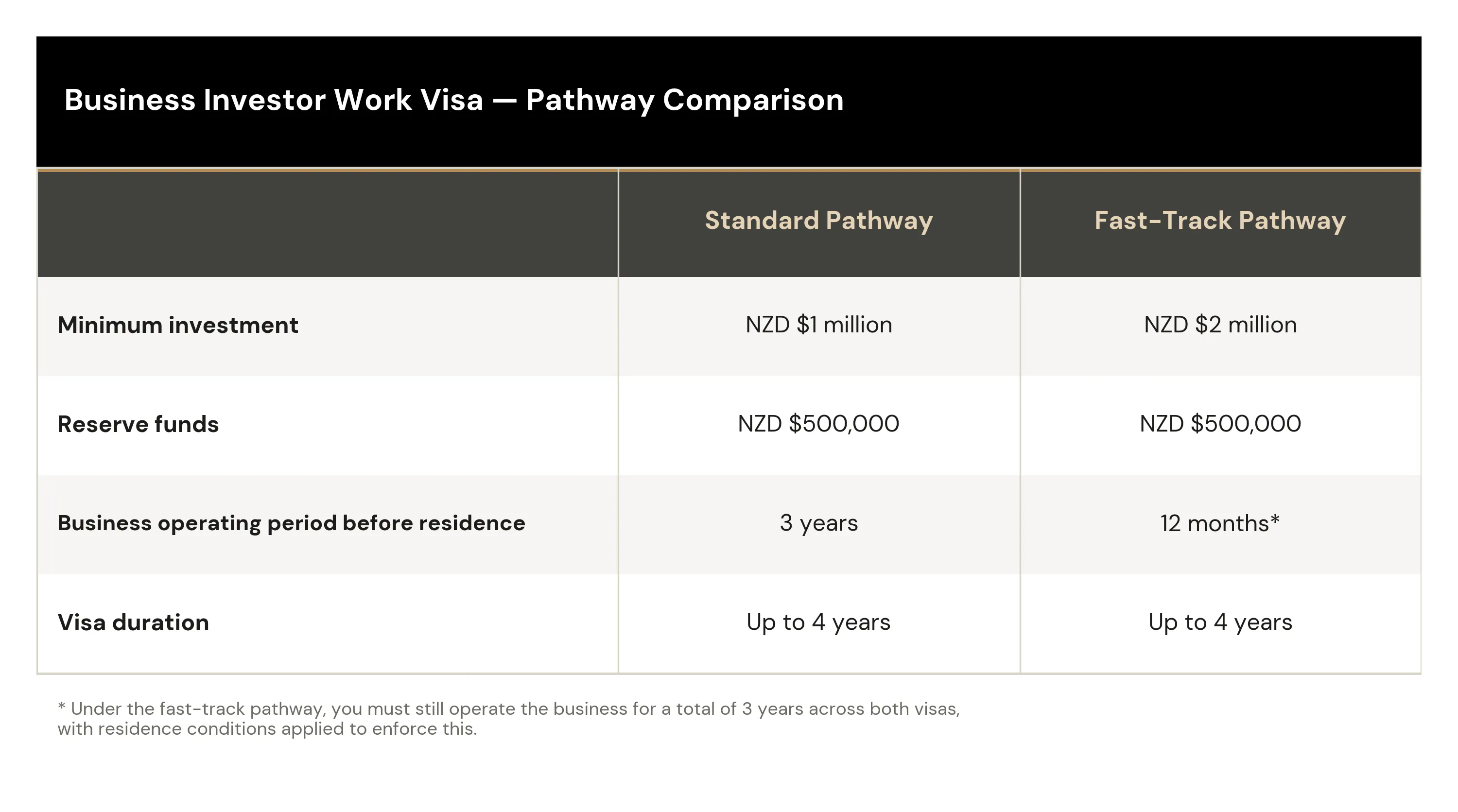
Applicants must also be aged 55 or under, meet a 3-year business experience requirement, speak English, and satisfy health, character, and fit and proper person tests.
The Three New Changes (Effective 6 July 2026)
1. Franchise Businesses Are Now Eligible
For the first time, applicants can invest in a franchise business that otherwise meets BIV requirements. A franchise offers a proven operating model, established brand recognition, and ongoing operational support — significant advantages for an investor who is new to the New Zealand market or entering an unfamiliar sector.
Provided the franchise business satisfies the core eligibility criteria — trading for at least 5 years, employing at least 5 full-time equivalent staff, purchase price of at least NZD $1 million (excluding property and GST), and resulting in at least 25% ownership — it can now be nominated as the BIV investment.
2. Purchase Through a New Zealand Resident Entity
Applicants can now acquire their nominated business through a New Zealand resident entity — that is, a company or other structure treated as a New Zealand tax resident. INZ will expect evidence of the full shareholding structure, but this is entirely standard in commercial practice.
This change removes a structural constraint that had no real policy justification. Most sophisticated investors hold business assets through corporate vehicles for liability, governance, and tax structuring reasons. The BIV now reflects that reality.
3. Gifted Funds Are Now Permitted (Where Lawfully Earned)
The Government has broadened how investment funds can be sourced, allowing gifted capital where it has been lawfully earned. The INZ visa page explicitly lists "evidence of funds or assets gifted" as acceptable evidence of lawful acquisition, alongside tax returns, business financials, property sale receipts, and share trading records.
This is the most significant change for many investor families. Previously, the emphasis on funds being earned by the applicant created friction for investors whose capital had been transferred by a parent, sibling, or business associate. Gifted funds from a family member — common in Chinese, Hong Kong, and Filipino investor communities — can now form part of the investment, provided the chain of lawful earning can be clearly documented.
Important: INZ will still scrutinise provenance carefully. Documenting gifted funds requires clear evidence of how the donor originally earned or acquired the capital — not just that a gift occurred. This is not a relaxation of the source-of-funds standard; it is a recognition that the recipient need not be the original earner.
What the Nominated Business Must Look Like
For those new to the BIV, INZ expects the nominated business to meet all of the following:
• Trading for at least 5 years
• Currently lawful and operating in New Zealand
• Purchase price of at least NZD $1 million (excluding property value and GST)
• Resulting in the investor owning at least 25% of the business
• Employing at least 5 full-time equivalent staff
• Not previously owned by the investor or a family member
• Not used in an approved investor or entrepreneur visa application in the last 10 years
The application requires a Business Proposal form, a valuation from a qualified statutory accountant, and confirmation of both financial and legal due diligence. The legal due diligence must be provided by a New Zealand lawyer who is separate from the immigration lawyer (though they may be from the same firm).
BIV vs Active Investor Plus: Which Pathway Is Right?
The BIV and the AIP are complementary pathways, not competitors. The right choice depends entirely on the investor's profile.
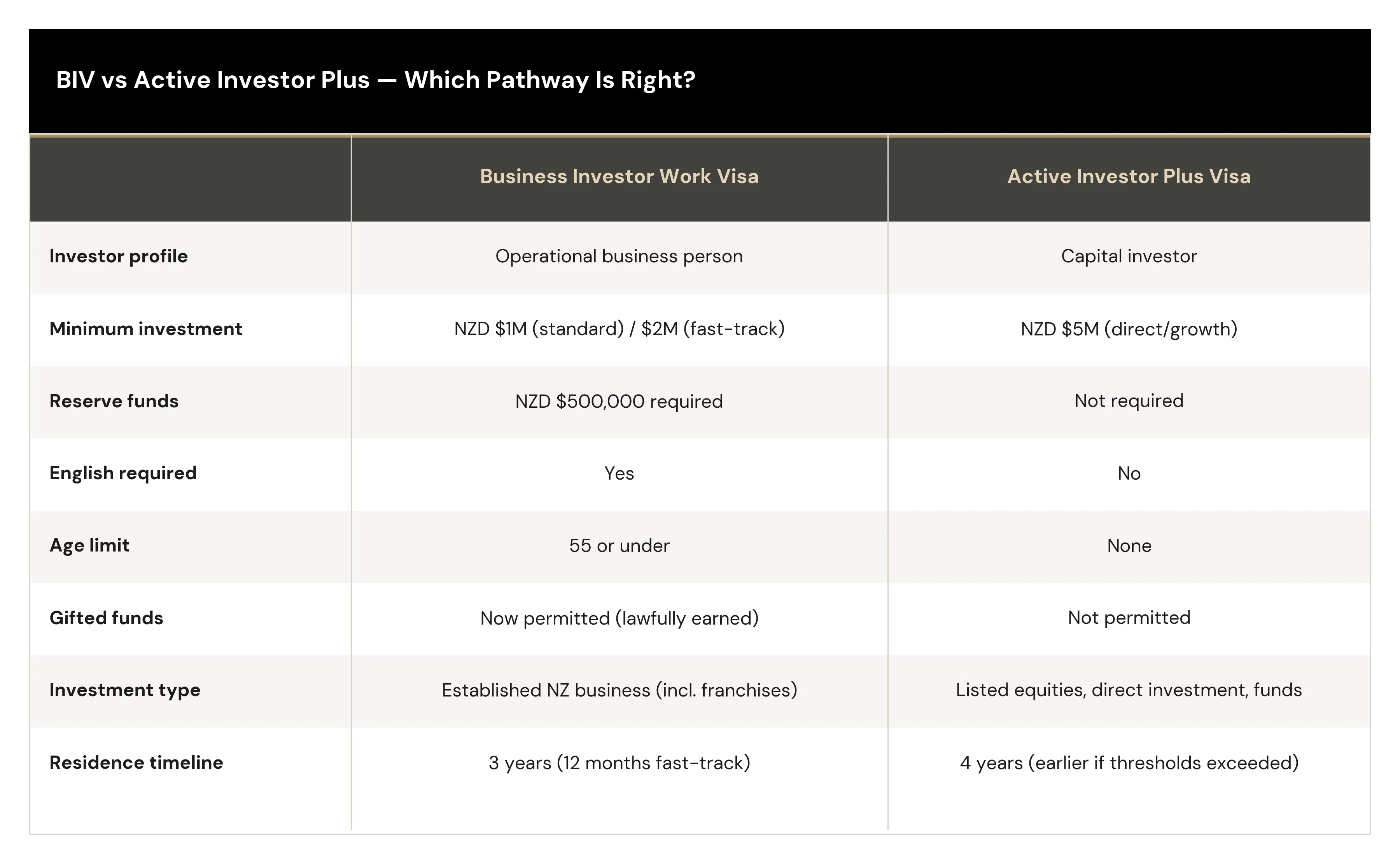
For investors with strong operational backgrounds who want to own and run a New Zealand business, the BIV is often the more natural fit. For those with significant capital and a preference for investment-style engagement, the AIP may be preferable. In some cases, a combined or sequential approach is worth exploring with specialist legal advice.
What the Changes Mean in Practice
For practices focused on Greater China, Hong Kong, and the Philippines — the three core source markets for BIV applications — these updates are genuinely useful:
• Franchises provide a cleaner entry path for investors who want to own a proven business without building from scratch.
• Entity-based acquisition aligns the visa framework with how experienced business people actually transact.
• Gifted capital directly addresses the wealth transfer patterns common in the families we work with. The key is documentation: the provenance trail must run from the original earner to the gift to the investment.
Next Steps
If you or your clients are considering the Business Investor Work Visa:
• Map the investment structure — direct ownership, franchise, or through a NZ resident entity — against the client's commercial and tax objectives.
• Audit the source of funds — whether earned directly or received as a gift, INZ will want a clear and well-evidenced provenance chain.
• Assess business experience — 3 years of qualifying experience is required: either self-employment (5+ staff or NZD $1M+ revenue) or senior management (5+ direct reports, NZD $5M+ turnover).
• Identify the nominated business early — the 5-year trading history, 5 FTE staff, and 10-year clean history requirements narrow the field meaningfully.
• Engage specialist legal advice — the interaction between visa eligibility, commercial structuring, funds compliance, and the residence pathway is complex and highly fact-specific.
At Queen City Law, we advise investors and their advisers on both the Business Investor Work Visa and Active Investor Plus Visa, with particular expertise in applications from Greater China, Hong Kong, and the Philippines. We work with clients to structure investments that are commercially sound, properly documented, and immigration-compliant from the first step.
Ready to discuss the Business Investor Work Visa or Active Investor Plus Visa for your circumstances? Get in touch with the team at Queen City Law.
This article is general information only and does not constitute legal advice. Immigration policy is subject to change. Please contact Queen City Law for advice tailored to your circumstances.
Queen City Law
Barristers and Solicitors
Queen City Law House
Level 8, 19 Victoria Street West
Auckland Central 1010

- ©2026 All rights reserved.


