

Invest New Zealand's latest data — released in response to an OIA request lodged by Queen City Law — gives the clearest picture yet of how AIP capital is being deployed across the market. The numbers tell a concentration story, and they help explain why we're seeing a shift in how "acceptable investment" is being interpreted at the margins.
The Headline Numbers
As at 28 February 2026, across the relevant AIP term (1 April 2025 – 28 February 2026):
● Total capital committed: $1,811,483,455
● AIP capital committed: $1,228,184,834
● Invested capital: $776,922,411
● Uncalled capital: $663,370,436
● Capital held in cash: $360,297,225
Invest NZ also flagged an important caveat: AIP capital committed may in fact be higher than reported, because wealth managers using nominee accounts don't always tag the underlying funds as AIP capital. In other words, the real concentration of AIP money may be even more pronounced than the official figures suggest.
Private Credit Dominates
Break the numbers down by fund type and the picture sharpens:
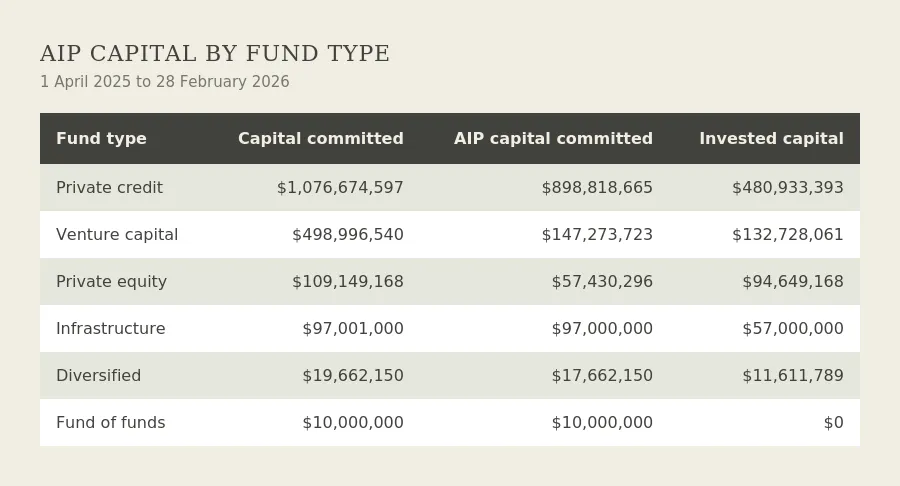
Private Credit alone accounts for roughly 59% of total capital committed and around 73% of AIP capital committed — by far the largest single category. That's consistent with what we're seeing at the coalface: the bulk of AIP investors are still routing capital into managed private credit vehicles rather than direct, asset-backed structures. It's the path of least resistance — established fund managers, clear governance, straightforward SIPO compliance — but it also means a large share of the programme's capital is sitting one step removed from the tangible, job-creating projects the policy was designed to encourage.
What Invest NZ Doesn't Track
Two points from the response are worth flagging for anyone advising in this space:
● Invest NZ doesn't hold data on capital sitting in on-call investments, bonds, listed equities, or bank/cash accounts at the individual investor level (their relevant response was simply "we do not hold this information").
● Invest NZ does not monitor downstream deployment of AIP-managed fund capital into underlying businesses or projects. They collect quarterly commentary on transactions and pipeline "for context on deployment rates," and expect fund managers to invest consistently with their SIPO — but there's no systematic tracking of where the money actually lands once it leaves the fund.
That gap matters. It means the compliance burden for demonstrating a genuine, qualifying investment sits heavily on the fund manager and the investor's advisors — not on any centralised INZ oversight of outcomes.
The "Project" Shift in Growth Investment
Where this gets interesting is at the edges of the acceptable investment categories. The inclusion of "Project" within the Growth Investment settings has opened the door to a wider range of qualifying structures than the market initially expected. The Plimmerton development in Wellington is a good example: the $135M infrastructure investment justifiable through a social housing component. It is probably fair to say that this sort of investment would not have been considered compliant a year ago.
We're seeing more of this asset-backed, project-anchored structuring come through, and a number of our clients are actively working in this space — the Wolfe Project among them.
Who's Moving
On the fund manager side, we've had the privilege of acting for MA Financial on their Queenstown acquisition, and we continue to work alongside Pioneer Capital — one of the more institutionally-minded private equity/private credit players active in the AIP space.
With an estimated 300+ AIP investors still searching for a qualifying home for their capital, and around 100 fund managers competing to attract it, the matching problem is real — and increasingly, it's being solved through more creative, asset-backed structures rather than another private credit allocation.
If you're a fund manager seeking AIP-qualifying capital, or an investor trying to work out what actually qualifies under the current settings, get in touch — this is a fast-moving space and the acceptable investment boundary is being tested in real time.
Queen City Law
Barristers and Solicitors
Queen City Law House
Level 8, 19 Victoria Street West
Auckland Central 1010

- ©2026 All rights reserved.


