

Immigration New Zealand asks a Growth investor to spend at least 21 days here over three years. Inland Revenue is asking a different question: has New Zealand become one of the places you actually live?
That distinction matters because an Active Investor Plus (AIP) visa is an immigration status, not a tax-residence ruling. You can satisfy the visa conditions without becoming New Zealand tax resident. Equally, you can become tax resident well before spending 183 days here if a New Zealand dwelling becomes your “permanent place of abode”.
For internationally mobile families, this is where the planning becomes interesting. A house can remain a holiday home. Children can study here without the parents necessarily becoming resident. One unusually long year may still be temporary. But a spouse and children settling into the family home, or a repeated seasonal pattern of living in the same house, can change the character of the connection entirely.
And behind that residence question sits another clock: New Zealand’s once-only transitional resident exemption for most foreign-sourced income. The start date can be worth far more than the cost of getting the advice right.
The Short Version
- The AIP visa itself does not make you New Zealand tax resident.
- Owning a New Zealand house does not, by itself, make you tax resident either.
- The risk is in how the home is actually used: frequency, duration, family life, work, belongings, intentions and the pattern that develops over time.
- There is no safe “under 183 days” rule if you have a permanent place of abode here.
- The four-year foreign-income exemption is valuable, but it is not a blanket exemption and its timing needs to be understood before the move.
Why this matters now
The AIP programme is no longer niche. Immigration New Zealand reports 949 applications since the April 2025 settings took effect, covering 3,092 people, with 496 applications approved as at 24 September 2026. Most applications - 813 of the 949 - are in the Growth category.
At the same time, Inland Revenue has released exposure draft PUB00548 specifically on when AIP holders can become tax resident through the permanent place of abode test. The draft is open for comment until 13 October 2026. It is not final and cannot yet be relied on as authoritative guidance, but it gives a remarkably useful view of how Inland Revenue is approaching common AIP fact patterns.
First principle: the visa and the tax test are different
The AIP settings are deliberately light on physical presence. Growth requires at least NZ$5 million invested for 3 years and 21 days in New Zealand during that period. Balanced requires at least NZ$10 million for 5 years and 105 days, with reductions available for qualifying additional Growth-category investment.
Tax residence operates on a different set of rules. Under the ordinary domestic tests, an individual can become New Zealand tax resident by being present for more than 183 days in any rolling 12-month period, or by having a permanent place of abode in New Zealand. The permanent-place-of-abode test can apply even where the person has another permanent home overseas.
The practical point is: 183 days is not a safe harbour. It is one route into tax residence, not the only one.
What Inland Revenue's 13 AIP examples actually show
The draft is most useful when the examples are read together. They are not bright-line rules - Inland Revenue says that expressly - but they reveal the kinds of facts that change the answer.
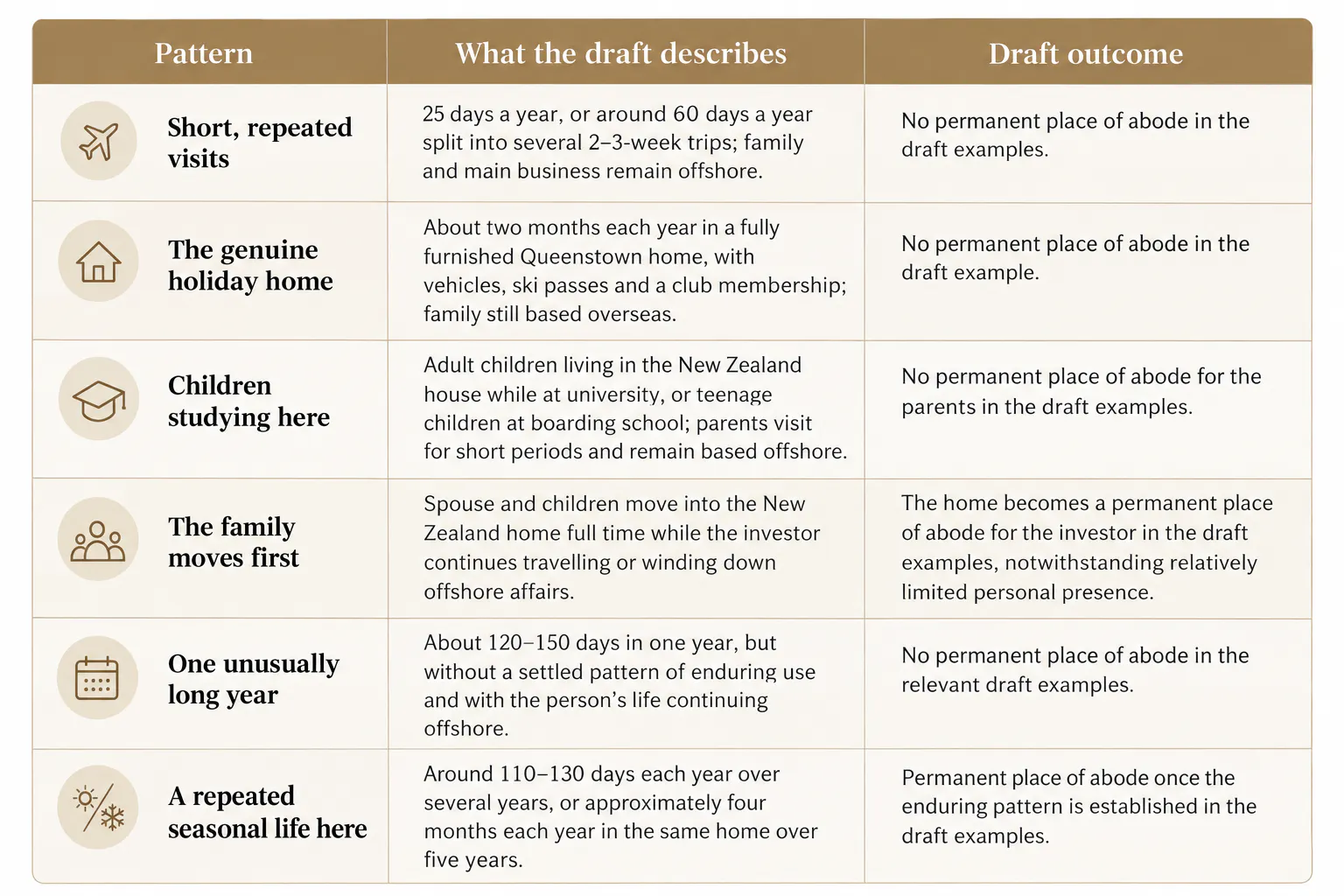
The trap is to turn those examples into a day-count table. They are not one. Inland Revenue says there is no fixed number of days or years that creates a permanent place of abode. The question is whether, looking at the whole picture, the person has begun habitually residing in the New Zealand dwelling on an enduring rather than temporary basis.
The most useful lessons aren't really about day counts
1. Buying the house is not the trigger. Living it can be
Inland Revenue is explicit that buying a house in New Zealand does not, by itself, create a permanent place of abode - even if the investor intends to live there later. The character changes when the use of that house changes: regularity, duration, family occupation and the way the investor actually lives there matter.
2. The family move can matter more than furniture
The draft draws a useful distinction between children being in New Zealand and the family home actually moving here. Adult children studying at university, and minors at boarding school, do not automatically create a permanent place of abode for parents who continue to visit temporarily. By contrast, where a spouse and children move into the New Zealand house full time and the investor treats it as the family home, Inland Revenue’s examples reach the opposite conclusion.
For many AIP families, the most important date may therefore be a family-relocation date rather than a visa date. That is not a universal rule, but it is a fact pattern worth identifying before the move happens.
3. One long stay is not the same as an established pattern
The draft includes examples where a person spends around five months in New Zealand in one year, or around four months in a later year, without establishing a permanent place of abode. That is not permission to spend 120 or 150 days here safely. It shows something subtler: permanence is about the quality and durability of the connection, not simply the largest number on a travel spreadsheet.
4. Calling it a holiday home does not make it one
A label is weak evidence. Inland Revenue says that someone spending many months each year at a property may habitually reside there even if they describe the property as a holiday home and the visits as holidays. Equally, genuinely short and temporary holiday use can remain just that.
5. A stronger home overseas won't automatically answer the New Zealand question
The domestic test is not a competition to identify which country matters more. An investor can have a permanent place of abode in New Zealand even while retaining a principal home, family ties and most economic interests in Switzerland. Those offshore facts remain part of the overall picture, but they do not prevent the New Zealand dwelling from also becoming a permanent place of abode.
6. Active involvement can add weight, but context matters
Inland Revenue says the minimum AIP investment is relevant but should be viewed in the context of the visa requirements. Active participation in New Zealand businesses, governance or commercial affairs can carry more weight than passive investment; investment above the visa minimum, or held beyond the required period, may also assume greater importance in the overall assessment.
That does not mean “being active” creates tax residence. It means that, like the house, it is one piece of the factual picture.
275 is not the new 183
From 1 April 2026, qualifying visitors can be treated as non-resident for up to 275 days in any 18-month period. The regime was deliberately introduced to accommodate people spending substantial time here while continuing to work remotely offshore. For internationally mobile investors, that can be genuinely useful. It can also be misunderstood.
The 275-day regime does not override the permanent-place-of-abode test. Inland Revenue’s 2026 Act commentary says the special rule switches off the ordinary 183-day test for qualifying non-resident visitors, but the permanent-place-of-abode rule still applies.
The visitor regime also has conditions: among other things, the person must have been non-resident before qualifying, remain lawfully in New Zealand, remain tax resident elsewhere (or liable there on citizenship), avoid specified New Zealand-connected work. It is a useful bridge for the right facts, not a universal nine-month tax holiday.
The second clock: the four-year transitional resident exemption
For an eligible new tax resident - broadly, someone who has not been New Zealand tax resident for at least 10 years and has not used the exemption before - New Zealand provides a temporary exemption for most foreign-sourced income for approximately four years.
This is one of the most valuable parts of the New Zealand migration tax framework, but it is not a blanket exemption. Foreign employment income and foreign income from services are not exempt, and New Zealand-sourced income remains taxable. A founder continuing to work for an offshore business should therefore not assume that “foreign paid” means “foreign exempt”.
Under current law, the transitional-residence period starts when domestic New Zealand tax residence starts - including through a permanent place of abode - even if a double tax agreement treats the person as resident in another country for treaty purposes.
One important 2026 proposal
A tax Bill introduced on 10 September 2026 proposes to change that timing from 1 April 2027. Where a double tax agreement applies, the proposal would defer the start of transitional residence until the person tie-breaks to New Zealand under the treaty. That proposal is not yet law. For anyone planning a move around 2026–27, the distinction between current law and the proposed rule should be kept under review.
The four-year exemption is a runway, not the destination
Good migration tax planning should look beyond the exemption period. Once transitional residence ends, offshore investments may become subject to New Zealand’s foreign investment fund (FIF) rules (FIF rules are currently being reviewed). Inland Revenue notes that FIF income can arise before the investor actually receives cash, depending on the applicable method and asset. (Inland Revenue - FIFs).
The practical question is therefore not merely, “How do we preserve four years?” It is, “What does the family balance sheet look like in year five?”
That is particularly important where the family holds concentrated private-company interests, large offshore portfolios, foreign-currency arrangements or investments that are difficult to sell. Those issues deserve tax modelling before the exemption ends, not in the final month of it.
The AIP investment itself needs to fit the tax and liquidity plan
Immigration New Zealand expressly warns that Growth-category investments can be illiquid and can require commitments that extend beyond the minimum AIP investment period. Acceptance for AIP purposes is not an endorsement of the investment and investors are expected to undertake their own due diligence.
That matters because the visa term and the investment exit date are not necessarily the same date. An investor planning around the end of a three-year AIP period should read the actual fund or investment documents: capital calls, extension rights, transfer restrictions, distribution policy and reporting all matter.
Funding deserves the same care. Immigration New Zealand now permits borrowed funds in defined circumstances, including requirements around the lender, security, location of the nominated assets and whether liquidation is economically viable or practical. The immigration, commercial, tax analysis should be done before the funds move.
A better way to plan the move
The most useful AIP plan is not a tax plan bolted onto an immigration file at the end. It is one timeline showing the visa, investment, property, family and tax decisions together.
1. Map the immigration timetable: Record the investment period, required presence, transfer deadlines and any intended permanent-residence application.
2. Decide what the New Zealand home is actually for: Is it a genuine holiday base, a seasonal second home, or the home the family expects to settle into? The legal analysis follows the real use, not the description on the file.
3. Put the family plan on the same page: Where will the spouse live? Where will the children study? Boarding school, university and a spouse living full time in the family home are materially different fact patterns in Inland Revenue’s draft.
4. Map work and business involvement: Remote work for an offshore business, a New Zealand board role, active involvement in investee companies and a New Zealand office are not interchangeable. They can matter for both the visitor rules and the wider residence picture.
5. Identify the earliest plausible tax-residence date: Do not choose a date and try to force the facts to match it. Identify the dates on which the facts could realistically change - a family move, a new role, a longer pattern of stays - and obtain tax advice around those points.
6. Model the transitional-residence period under current and proposed law: For moves around 1 April 2027, advisers should track the proposed DTA alignment rule and not assume it has been enacted until it has.
7. Look at year five before year one: Review the offshore portfolio, private-company interests and liquidity position before the exemption expires. The aim is not simply to defer a problem; it is to know what the long-term New Zealand position will be.
8. Keep good records: Inland Revenue recommends retaining evidence of days in New Zealand, purpose of visits, family location, use of dwellings, business and financial interests, and personal property. Immigration New Zealand can provide arrival and departure records.
The point isn't to keep New Zealand at arm's length
The AIP programme is attractive precisely because it gives investors room to establish a relationship with New Zealand gradually. The tax rules do not prevent that. They simply mean the relationship should be understood as it develops.
A house can remain a holiday home. A child can study here without moving the parents’ tax residence. A family can spend meaningful time here before deciding to settle. But once New Zealand starts to look less like a place you visit and more like a place you live, the tax analysis should catch up with reality.
For AIP investors, the best question is not “How many days can I get away with?” It is “What do we want New Zealand to become for our family, and what order should the important decisions happen in?”
That is a better question legally, commercially and practically - and it usually produces a better plan.
How Queen City Law can assist
Queen City Law advises on Active Investor Plus applications, qualifying investment and funding issues, property and related New Zealand legal work. AIP investors should obtain specialist New Zealand and home-jurisdiction tax advice on their individual circumstances; the important thing is to coordinate that advice with the immigration and investment plan before the major decisions are locked in.
For a family already considering a New Zealand home, school move, business involvement or capital transfer, the useful time to map the sequence is before those steps occur - not afterwards.
General information only. This is not legal, tax or investment advice. Inland Revenue’s PUB00548 remains an exposure draft as at 1 October 2026, and the proposed 2026–27 tax amendments discussed above are not yet enacted.
Official sources
Inland Revenue - PUB00548: AIP visa holders and the permanent place of abode test (exposure draft)
Inland Revenue - Tax residency status for individuals
Inland Revenue - Temporary tax exemption / Foreign Income Guide
Inland Revenue - 2026 Act commentary: tax treatment of visitors to New Zealand
Queen City Law
Barristers and Solicitors
Queen City Law House
Level 8, 19 Victoria Street West
Auckland Central 1010

- ©2026 All rights reserved.


